In the late 17th and early 18th centuries, the Imperial city of Meknes must have been a dazzling, showstopping affair.
Founded by the Almoravid dynasty in the 11th century, in 1672 the city was chosen by Moulay Ismail, one of Morocco’s great kings, as his new capital.
He set about building an enormous palace complex surrounded by thick walls, in the hope of creating Morocco’s answer to Versailles.
In 1755, the city was damaged by the Lisbon earthquake and Moulay Ismail’s grandson, Mohammed III, decided to move the capital to Marrakech.
Today the city is home to more than half a million people, making it the sixth biggest city in Morocco.
While Meknes is a shadow of what it would have been like in its Imperial heyday, there are glimpses of its former glory to be found throughout the old city.

We started our visit at the stunning Bab el-Khemis (above) on the western edge of the old city.
The large, ornate 17th century Thursday Gate leads to the city’s Jewish quarter. It’s decorated with beautiful zellij tiles and features an Arabic description along the top.
We spent a little while admiring the gate then headed into the kasbah.
Meknes’s kasbah boasts two sets of walls, an inner and outer set, making it a bit like a Moroccan version of a concentric castle.
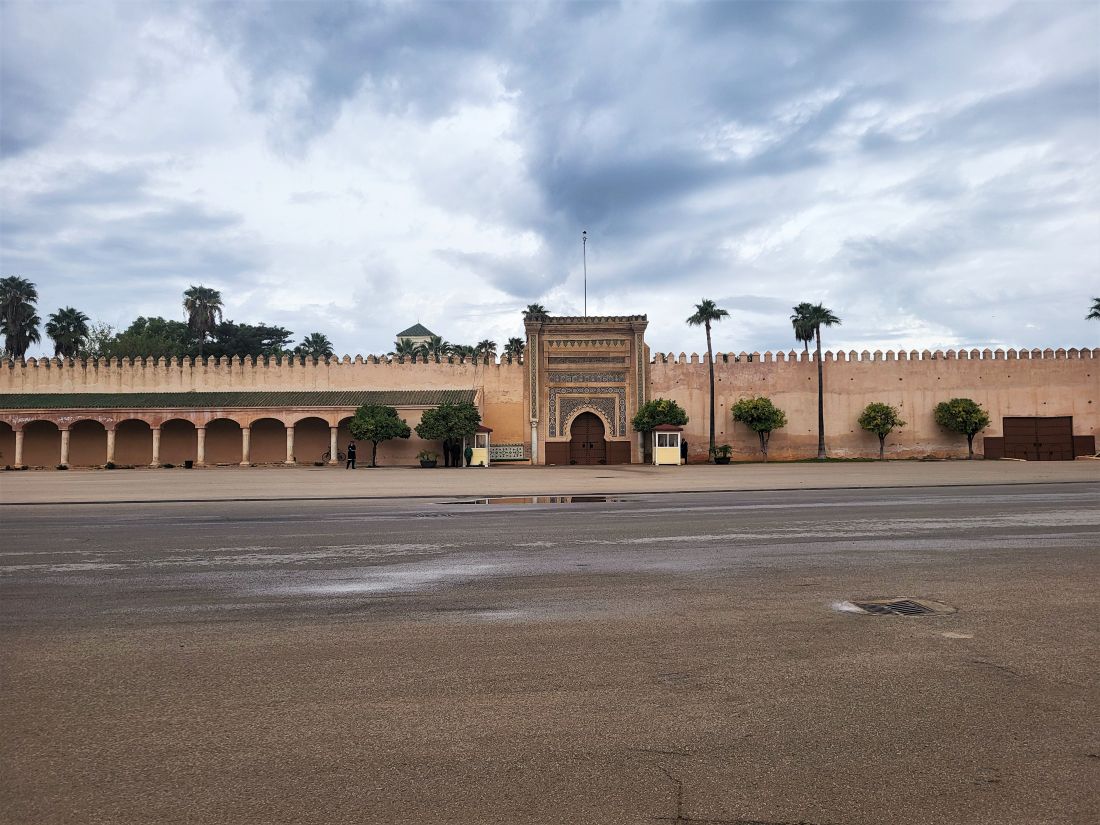
It wasn’t long before we stopped at the entrance to the royal palace to take a look at the pretty gate (above), which was covered in ornate zellij tiles, and take some photos.
The current king Mohammed VI doesn’t live in the palace and apparently never visits, but they keep it ready for him just in case he decides to stop by.
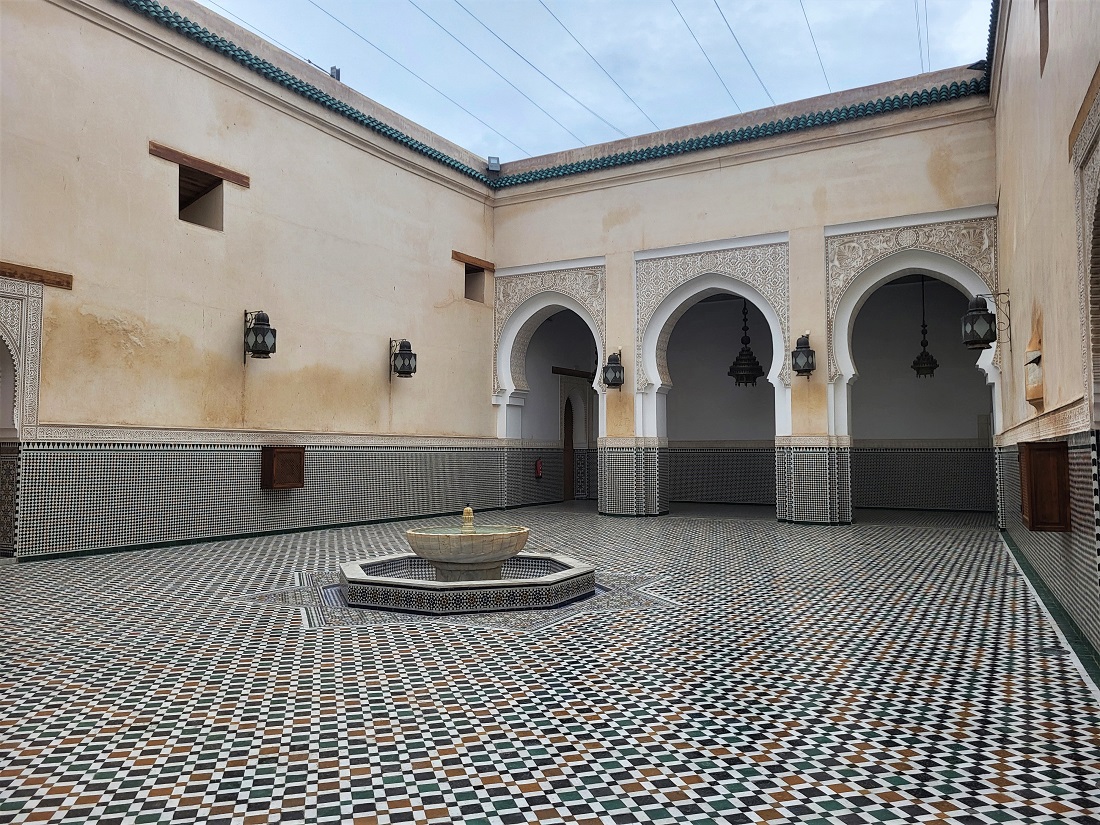
We continued our drive through the kasbah to our next port of call, the Mausoleum of Moulay Ismail (above).
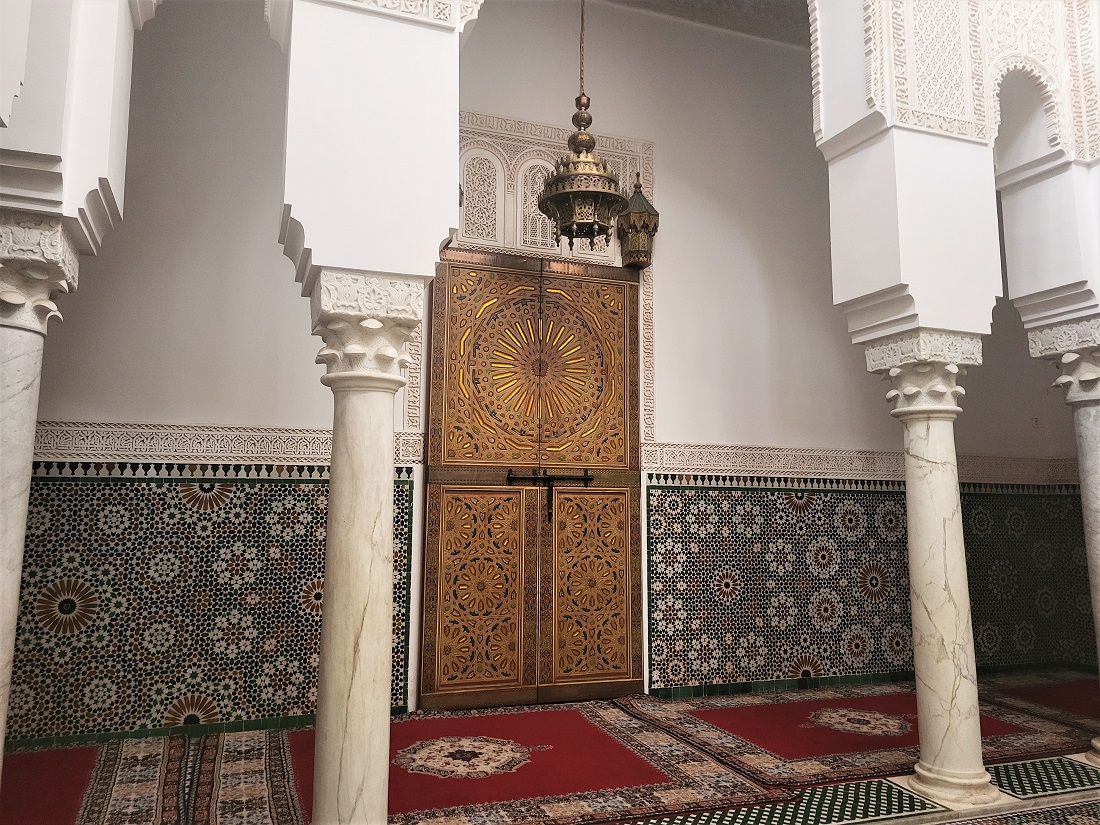
Situated inside a mosque, the mausoleum is the resting place of Moulay Ismail, his wife and his son Ahmad ad-Dhahabi, who succeeded him as king, as well as a 19th century king, Moulay Abd ar-Rahman.
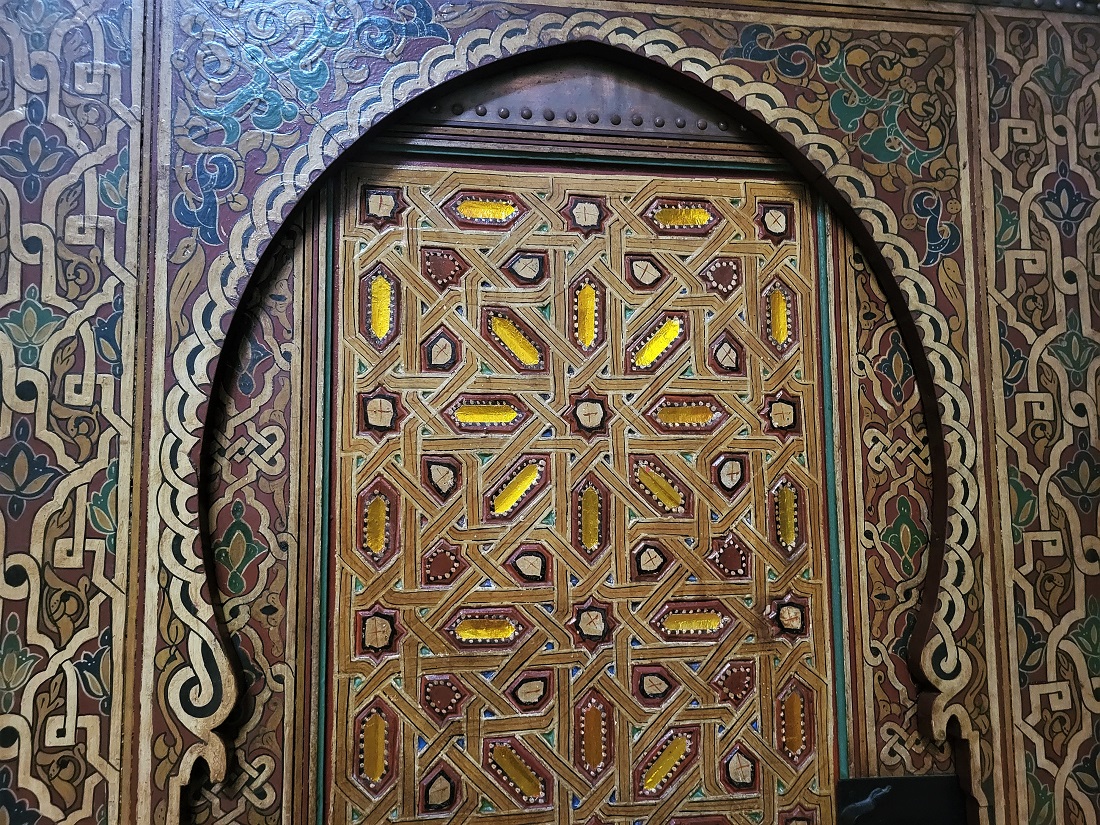
The pretty mausoleum is embellished with zellij tiles and handcarved stucco, as well as handcarved and painted wooden ceilings and doors (above).

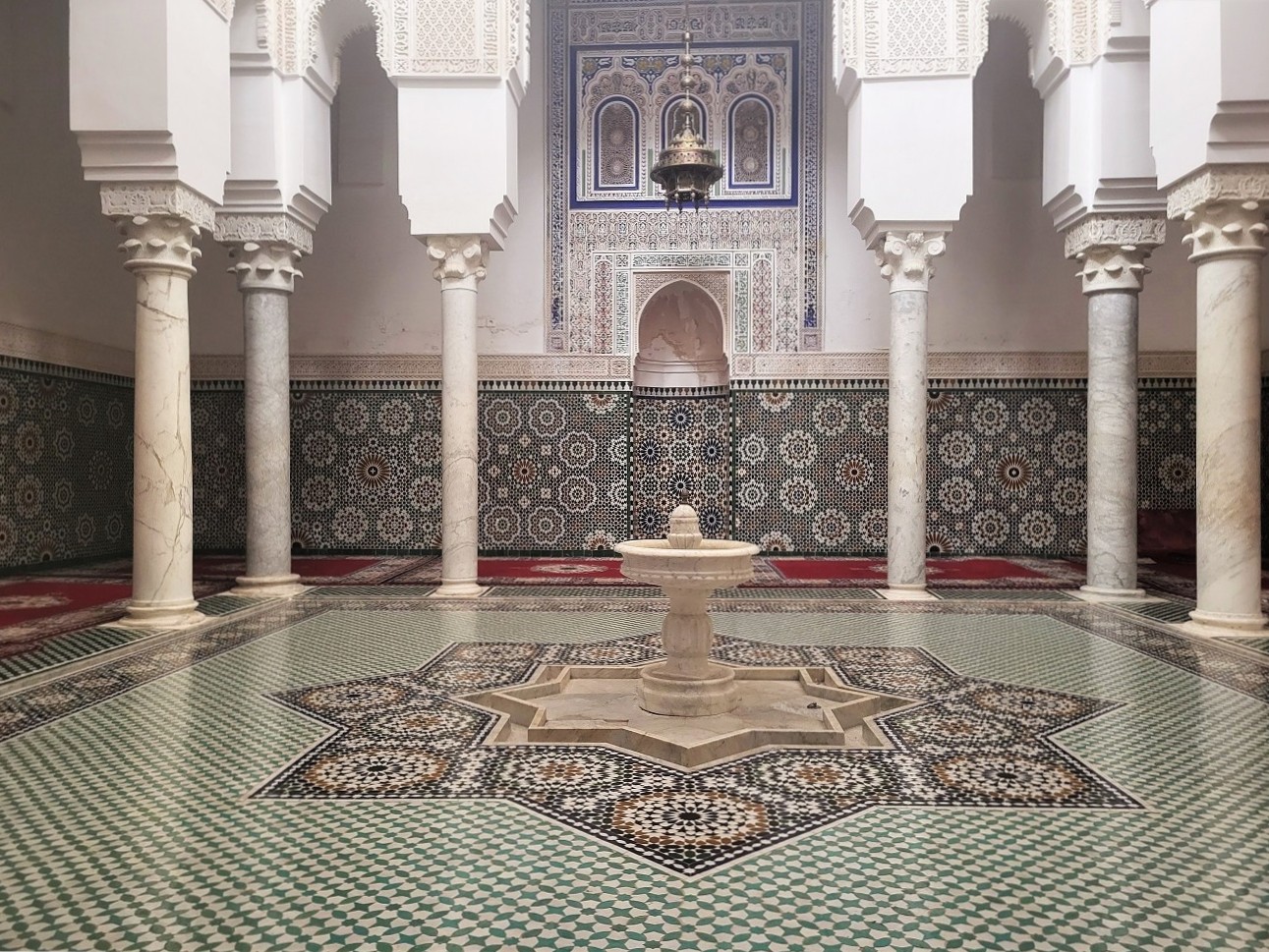
On going inside, we passed through a series of small courtyards, and then took off our shoes to look around the spectacular ablutions room (above).
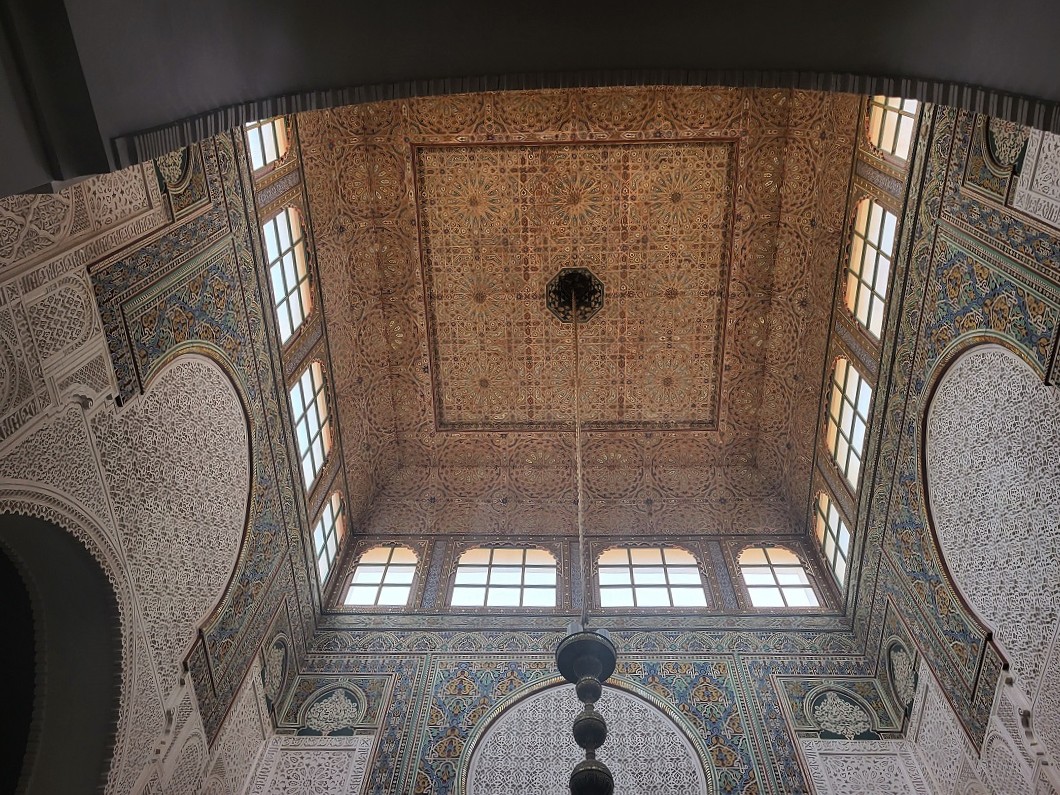
The small, tall, square room boasts 12 marble columns, a star-shaped fountain, more zellij tiles and painted wood and stucco, as well as a gorgeous ceiling (above).
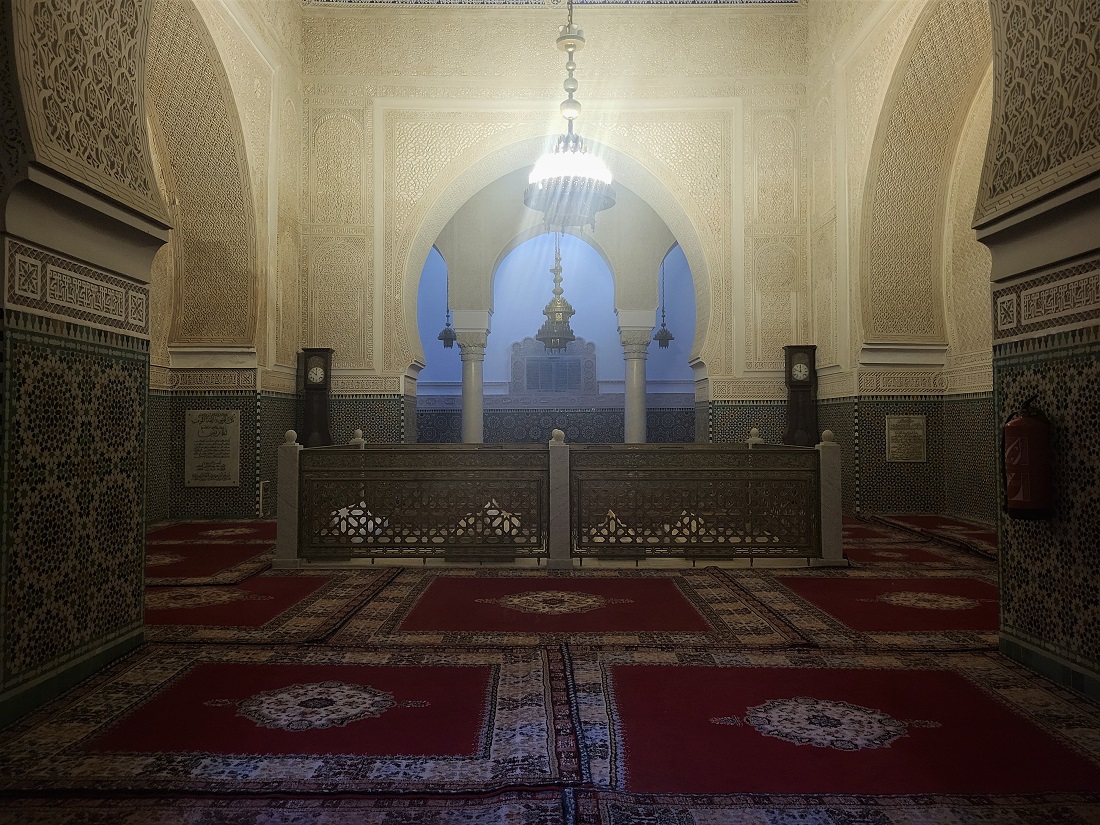
To the right, behind a cordon, are the tombs of Moulay Ismail, his wife, son and grandson (above).
It’s an elegant, understated space and quite simple compared to the lavish tombs you see in some European palaces and cathedrals.

After looking around the mausoleum, we crossed the road to take a look at Royal Golf de Meknes, a golf course located inside the royal palace, which is also home to a fair few storks (above).
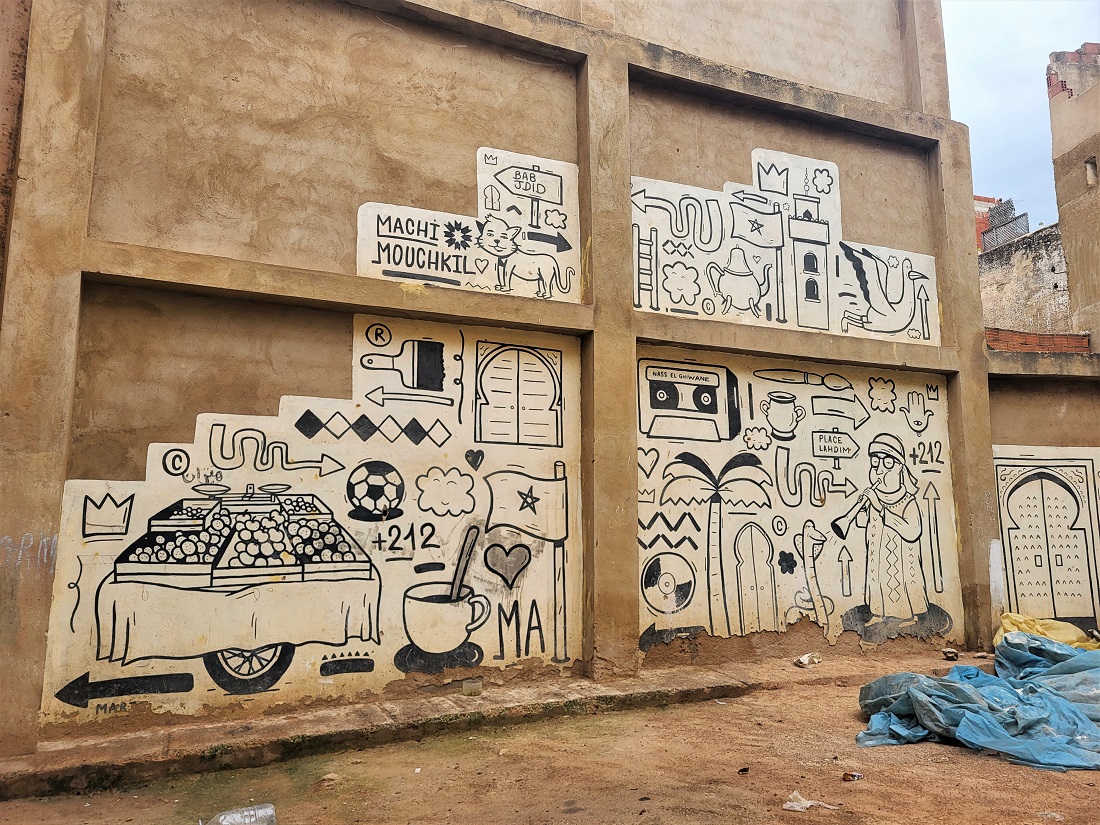
We then made our way out of the kasbah and into the medina (above).
The medina’s narrow warren of alleyways was quite scruffy and rundown, but they were in the process of restoring parts of it when we visited.
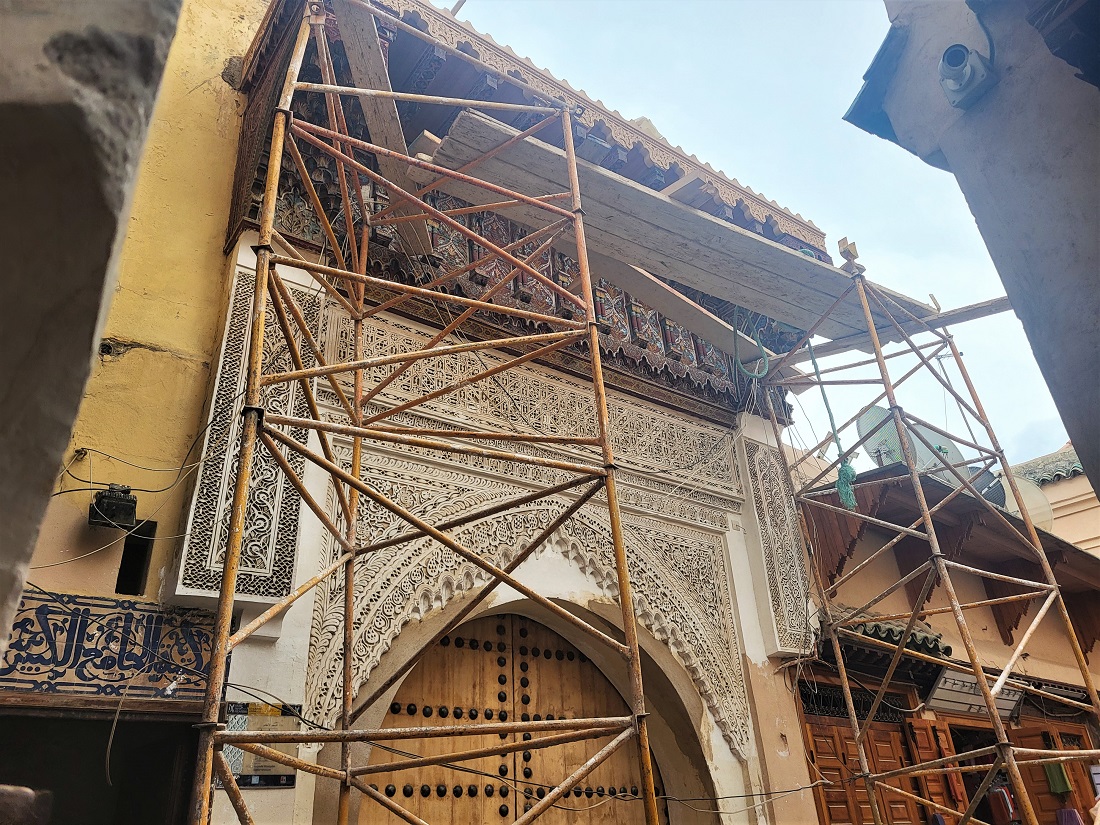
As we wandered through the busy medina, we passed a mix of houses, riads and shops, along with a mosque that was being restored (above).
There were lots of people bustling through at speed and, at times, it was difficult to know where to stand to avoid getting in people’s way.

We emerged from the medina in Place el-Hedime (the square of ruins, above), one of the city’s two market squares.
There was a snake charmer in the market and the sound of his flute resonated around the square.
The square lies in front of Bab Mansour el-Aleuj, the Gate of Victorious Renegade, one of the city’s most impressive gates, which was built between 1672 and 1732.
Sadly, the gate was in the process of being restored so it was under a huge tarpaulin, which meant we couldn’t take a look at it.
If I’m being honest, I was underwhelmed by my visit to Meknes.
Quite a few of the main sights were closed when we visited last November because the city was undergoing massive restoration work. Maybe if they’d been open, I’d have formed a different opinion.
It was okay and I had a nice time, but I didn’t see anything that particularly blew me away.
 Little Old World
The tiles etc are still beautiful – maybe you were getting a bit blasé about them after seeing so many?
LikeLiked by 1 person
The zellij tiles were lovely, especially in the mausoleum. But I think you may be right that I was a little blasé about them. It probably didn’t help that I visited Meknes straight after Rabat and the jaw-dropping opulence of the Hassan II Mosque in Casablanca.
LikeLiked by 1 person
It makes you wonder what the city would have looked like before the earthquake. I can’t get over how beautiful the tilework is. Sorry to hear you found Meknes a bit underwhelming. But hey, visiting the underwhelming places helps you appreciate the good ones!
LikeLiked by 1 person
I get the impression it must have been quite spectacular in the early 18th century before the earthquake. The tiles on the gates and in the mausoleum were very pretty. That’s very true! I don’t think it helped I visited Meknes after Casablanca and Rabat, maybe if I’d visited Meknes first I’d have felt differently about it.
LikeLiked by 1 person
I’d like to return to Mike’s in a few years when the gates have all been restored, but you’re right, as it is, the city is a little underwhelming. Did you go to Moulay Idriss?
LikeLiked by 1 person
It’s interesting you also found Meknes a bit underwhelming. I agree, it would be good to go back when the restoration work has finished and all the sites are open. I didn’t feel I saw the city at its best. No, I drove past Moulay Idriss on the way to Volubilis, but didn’t have time to stop and look around.
LikeLike
I just noticed my spell check error. Not Mike’s, Meknes, but I’m sure you realized. It did it again when I was typing this too! 😅
LikeLiked by 1 person
Mike’s and Meknes are kind of similar… 😅
LikeLike
Such an honest take! Sometimes places under restoration can feel a bit underwhelming, but your photos and details still make Meknes sound so full of history and charm.
LikeLiked by 1 person
It would be interesting to go back once the city’s been restored to see if it changes my opinion. I definitely didn’t feel as though I saw Meknes at its best.
LikeLiked by 1 person
That would be amazing to see, almost like watching the city come back to life! It’ll be interesting to compare your impressions then to now.
LikeLiked by 1 person
Definitely doesn’t sound like a trip that blew you away! When things are under construction it always puts a bit of a dampner on exploration!
LikeLiked by 1 person
Thanks Hannah 🙂 It was nice enough, but there wasn’t anything that wowed me. It would be interesting to go back once the city’s been restored to see if I feel differently about it.
LikeLike
It’s hard when so many things are under construction. You want to be amazed at what you’re seeing, but what you’re seeing is scaffolding.
LikeLiked by 1 person
Thanks Meg 🙂 As you say, it’s difficult to be wowed by a place when you’re seeing scaffolding and tarpaulins. I’d like to go back to Meknes in the future once it’s been restored to what it’s like.
LikeLiked by 1 person