
While I was at Berkeley Castle, I learned that Dr Jenner’s House was just a five minute walk away.
So after looking around the castle, I walked over to the house, as I was keen to see where the ‘father of immunology’ had lived and worked.
Dr Edward Jenner was born in Berkeley in 1749, the son of a local vicar, and after finishing his medical training in London, he returned to the Gloucestershire town.
He bought his house, The Chantry, in 1785 and lived there with his wife Catherine and their family.

In 1796, Dr Jenner cemented his place in history for his work pioneering the smallpox vaccine, after he theorised he could use the pus from cowpox blisters to innoculate against the more deadly smallpox.
Dr Jenner tested his theory on James Phipps, the eight-year-old son of his gardener, and a revolutionary, life-saving technique was born.

When I arrived at the house, I was given a quick introductory tour by one of the friendly and helpful volunteers, who showed me the best route to take, and then set off to explore at my leisure.
I started my visit in the study (above), which is sealed off behind a glass panel. The most notable item in the room is the wicker chair, which once belonged to Dr Jenner’s wife Catherine Kingscote.

The house has been turned into a museum by the Historic Houses Association and features a series of small exhibitions, the first of which recounts Dr Jenner’s life story (above).
I hadn’t realised before my visit that Dr Jenner was involved in so many fields of research and was intrigued to learn he’d been made a fellow of the Royal Society in 1788 for his work on nested cuckoos.
I was also fascinated to discover that Dr Jenner was a hot air balloon enthusiast and launched one of the world’s first hot air balloons from Berkeley Castle in September 1784.
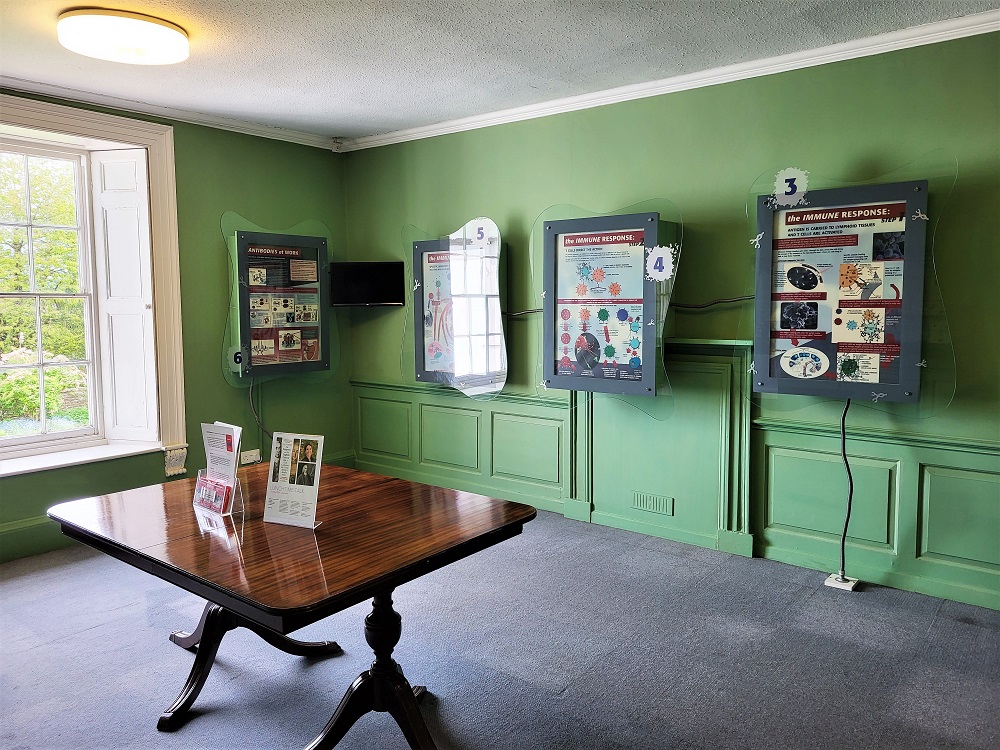
Upstairs there are two more displays – the first of which is an informative look at how immunology and antibodies work (above).
The second provides more information about Dr Jenner’s life, along with insight into the history of vaccination and the eradication of smallpox (below).
One of the most curious items on display was a letter from Dr Jenner to Napoleon, as I never would have guessed the two had written to each other.

On reading the display panels, I was amazed to learn that for as long as we’ve had vaccines, we’ve had anti-vaxxers.
For some reason, I thought it was a more modern phenomenon dating back to Andrew Wakefield’s 1998 study, in which he falsely linked the MMR vaccine to autism.
It was really interesting to read about the history of anti-vaccination and some of the extreme steps people have taken over the years.
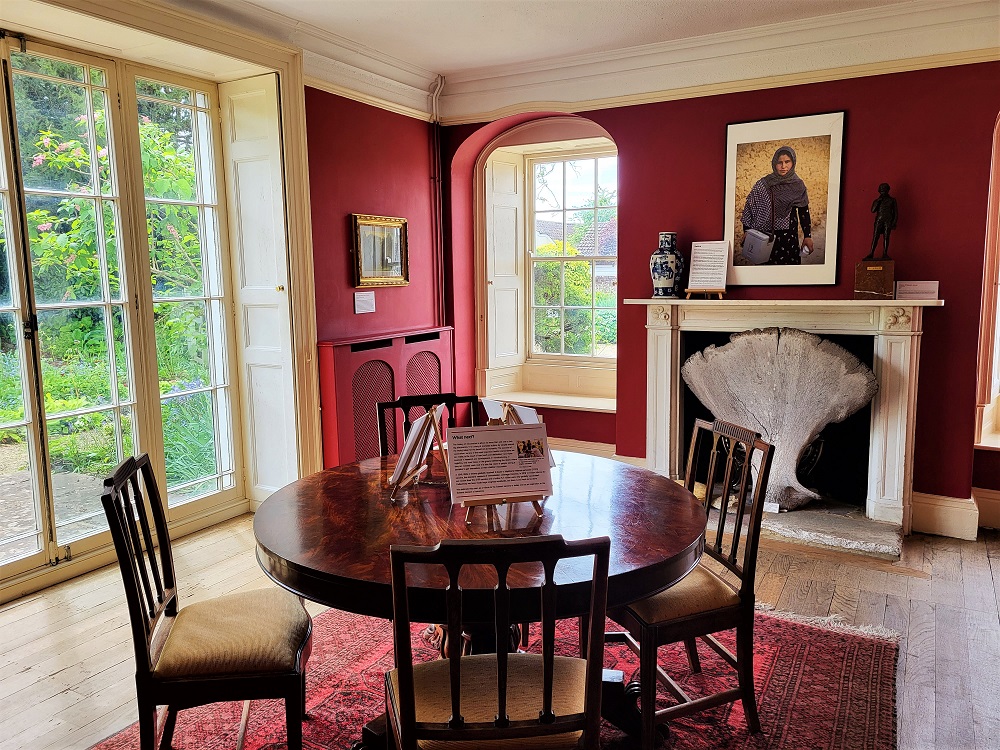
Back downstairs, I had a quick look around the morning room (above), before making my way outside to the large garden (above), via the potting shed.

My first port of call was the small physic garden (above), which is split into four sections planted with flora that have traditionally been used as remedies for different ailments.

At the back of the garden, hidden among some trees, is the Temple of Vaccinia (below), a small thatched hut built for Dr Jenner by his friend, the Reverend Robert Ferryman.

The temple is where Dr Jenner used to vaccinate local people against smallpox free of charge (below).

It was incredible to step inside this small, unassuming building that has played such a pioneering role in the history of immunology.
I enjoyed my visit to Dr Jenner’s House, it was really informative and I learned a lot about Dr Jenner’s life and the history of vaccination.
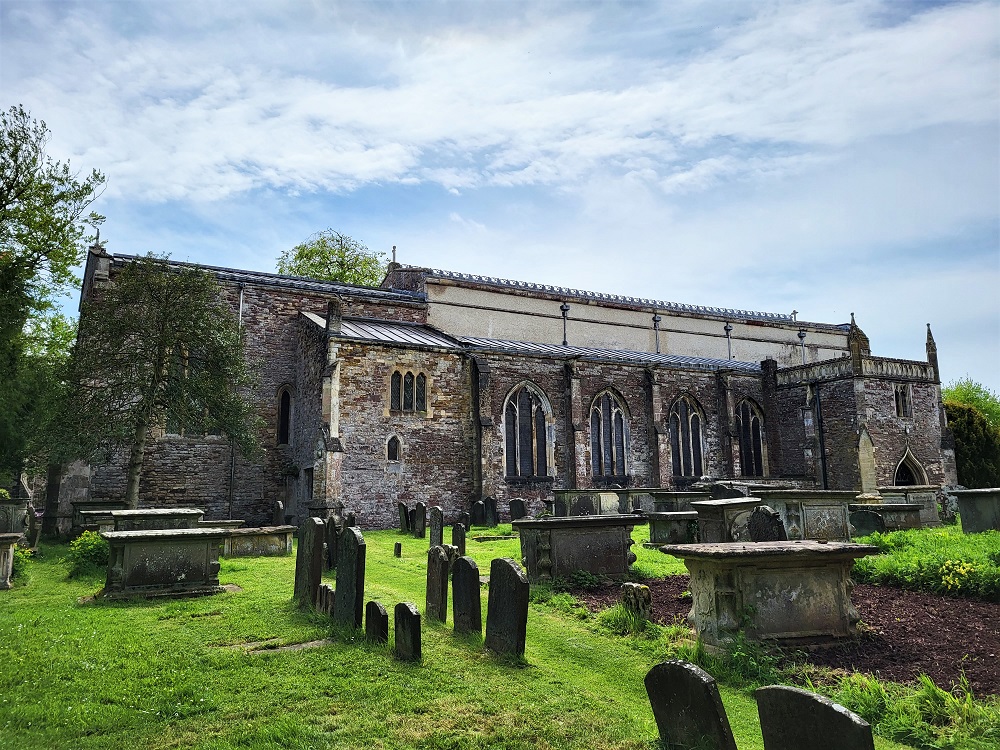
On my way back to Berkeley Castle, I stopped to take a look at St Mary’s Church (above), which lies between Dr Jenner’s House and the castle.
St Mary’s Church dates back to the first half of the 13th century, although it’s thought there’s been a church on the site for a lot longer.

From the outside, it looks like a fairly typical parish church, but inside, I was stunned to find the walls were adorned with decorative patterns (above). It was a striking sight and a welcome surprise.
I think the only other British church I’ve come across with painted walls is St Teilo’s Church at St Fagans Museum of National History in Cardiff.

The paintings came to light when St Mary’s was being restored in the mid-1860s.
As part of the restoration work, the builders removed the whitewash and plaster covering the walls and found decorative patterns underneath dating back to the 13th and 14th centuries.
So the Victorians decided to revive the old designs and traced over the original patterns.

At the far end of the church, near the High Altar, lies the Jenner family tomb where Dr Jenner is buried, alongside other members of his family (above).
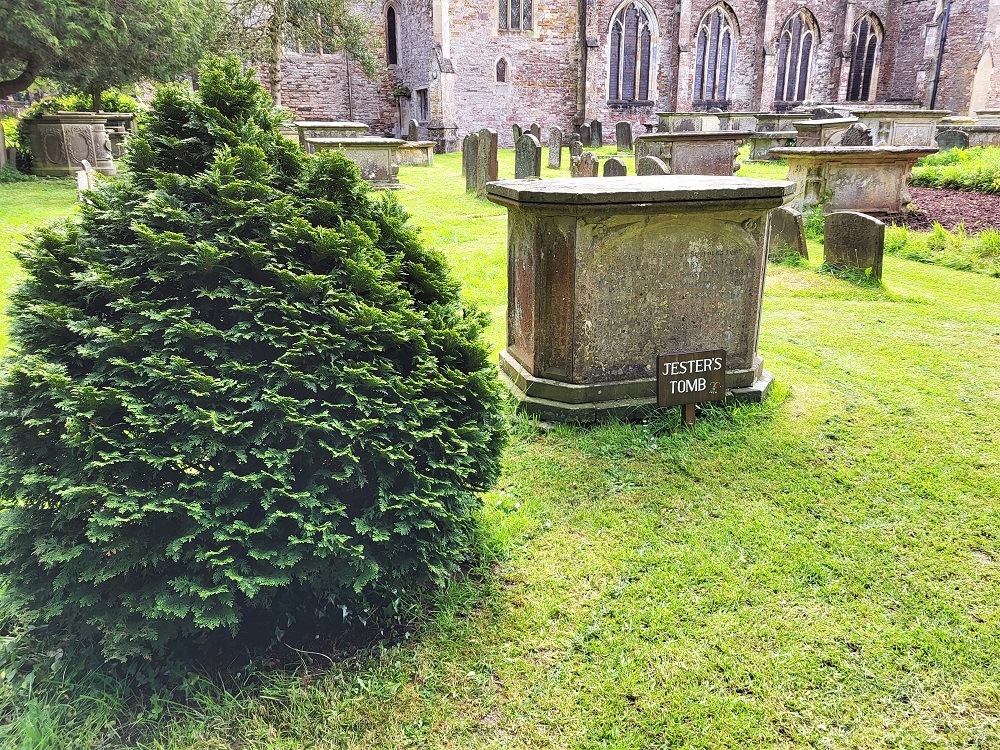
After looking around the church, I spent some time walking around the cemetery, where I came across the tomb of the jester who was killed in the great hall at Berkeley Castle (above).
If you ever visit Berkeley, it’s well worth stopping by Dr Jenner’s House and St Mary’s Church, too, as both are interesting and informative places in their own right.
Info
Dr Jenner’s House, Church Lane, Berkeley, Gloucestershire GL13 9BN
£8 adults, £5 children (five to 16), free for under fives
Open Wednesday to Sunday until the end of September
jennermuseum.com
 Little Old World
I actually have never heard of this brilliant man before. Looks like a fascinating museu. Thanks for introducing me to it. Maggie
LikeLiked by 1 person
Thanks Maggie, it was a great little museum. Dr Jenner’s quite well known in the UK and was voted one of the 100 greatest Brits of all time a few years ago.
LikeLiked by 1 person
Hello Maggie. I’m not sure if I’d heard of him before. The world certainly owes him a huge “thank you” for his great work.
LikeLiked by 1 person
Thanks Neil. I couldn’t agree more, we owe him a massive favour.
LikeLiked by 1 person
Interesting to hear that anti-vaxxers are not a modern phenomenon.
LikeLiked by 1 person
It was fascinating to read about its history.
LikeLiked by 1 person
Hi. I realized that my comment above has a typo. That is, I know your name isn’t Maggie. Take care.
LikeLiked by 1 person
No worries, it’s an easy mistake to make. Thanks Neil.
LikeLiked by 1 person
I’m such a fan of these types of house museums. Sounds like a great way to learn more about an important person from the past and try to imagine how they once lived. Glad you also had time to visit St Mary’s Church as it looks quite lovely.
LikeLiked by 1 person
I’m glad I left enough time to visit the museum and the church. They were a really lovely and informative way to end a fascinating day out.
LikeLiked by 1 person
What a handsome house! And I’d never heard of him but he sounds very itneresting.
LikeLiked by 1 person
It was a charming house and garden. He’s a fascinating man and was named one of the 100 greatest Britons a few years ago.
LikeLiked by 1 person