
Malaysia’s cool capital city is a mix of old and new: world-famous skyscrapers like the Petronas Twin Towers, modern Islamic architecture and the heritage buildings of its colonial past.
I really liked Kuala Lumpur (or KL as it’s sometimes known for short) and had a great time there, but it’s not a city for pedestrians.
It’s a nightmare to walk around and the public transport often, weirdly, doesn’t go to popular tourist destinations, which makes Grab (the Southeast Asian equivalent of Uber) a bit of a necessity.
I started my two days in the city by visiting a trio of national sites: the Istana Negara (royal palace), the Tugu Negara (national monument) and the Masjid Negara (the national mosque).
Istana Negara (National Palace)
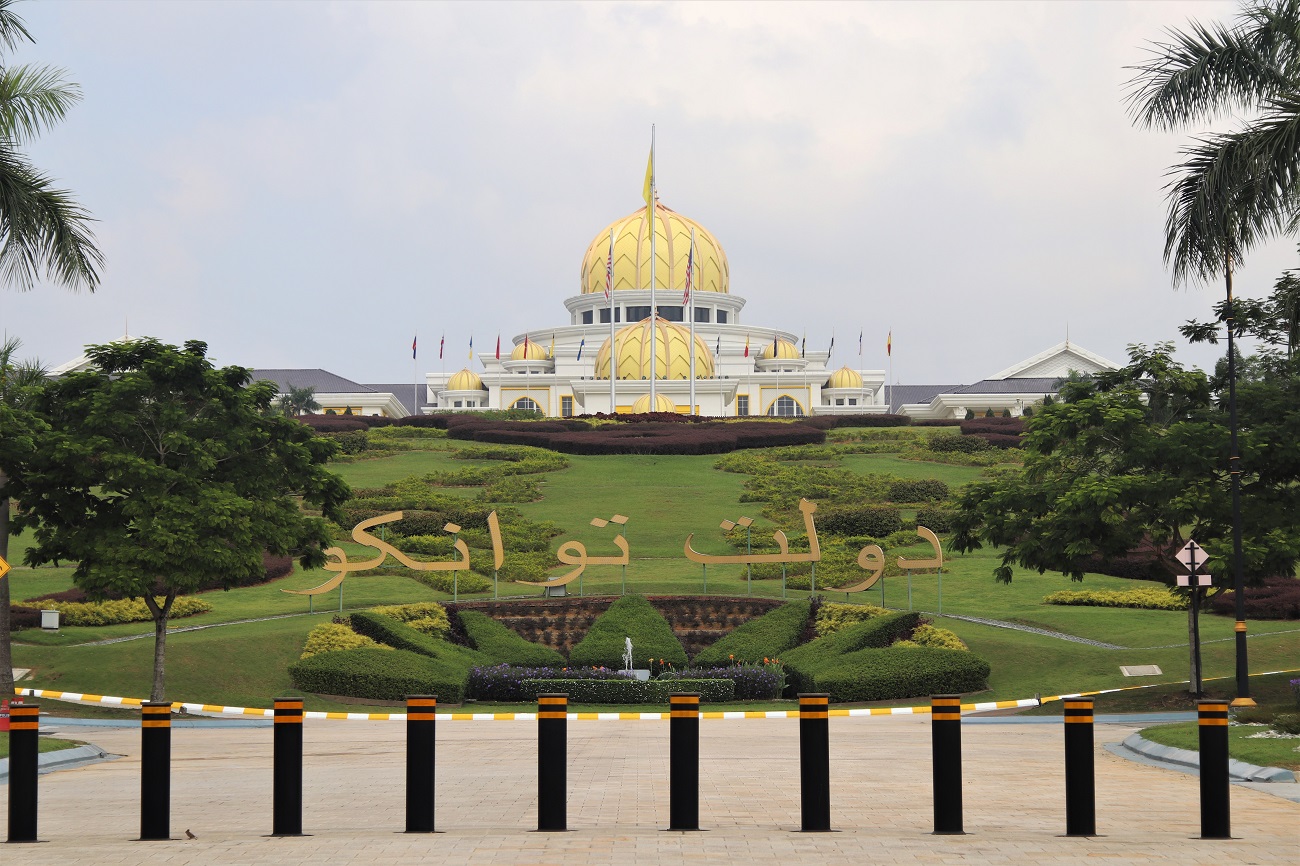
The official home of the king of Malaysia, Istana Negara was opened in 2011 to replace the old royal residence in the centre of Kuala Lumpur.
The new palace is situated on a hill to the north-west of the city and is set among almost 100 hectares of grounds.
The huge, gold-domed palace (it boasts 22 golden domes in all) is a shiny affair and somehow didn’t look very real as I gazed upon it from a distance.

Visitors can’t go inside the palace, so you have to make do with standing outside the enormous gates (above) and taking photos.
It’s worth noting, the palace isn’t easily accessible from the city centre and you’ll need to take a Grab or a taxi to get there.
Tugu Negara (National Monument)

Opened in 1966, the National Monument was built to commemorate all those who died in the First and Second World Wars and the Malayan Emergency (a guerrilla war fought by communist insurgents against the British Empire between 1948 and 1960).
Located in the city’s Lake Gardens, the enormous monument was damaged in August 1975 when it was bombed by four communist guerrillas, reopening two years later after extensive repairs.

At the heart of the monument is a giant statue of seven soldiers holding the Malaysian flag (above).

Designed by the Austrian sculptor Felix de Weldon, the brash, bold, bronze statue stands at 49ft tall and I was struck by how different it was compared to the tranquil, poignant memorial at Sandakan in Borneo.

The memorial is also home to a cenotaph (above), which was originally built by the British to commemorate the First World War. It moved to its current location from the city centre in 1964.

The memorial was attractive, but I was stunned by how many people were taking selfies and posing for photos as I walked around.
It felt very disrespectful and distasteful in a place built to commemorate the dead, and it was uncomfortable to witness. It slightly spoiled what was otherwise a pleasant, respectful monument.
Masjid Negara (National Mosque of Malaysia)

Masjid Negara, or the National Mosque of Malaysia, was built in 1965 and is a strikingly beautiful building.
The mosque can hold up to 15,000 worshippers, making it one of the biggest in Malaysia.

Visitors aren’t allowed in the main prayer hall (above), but you’re free to wander around the rest of the complex.
To do so, I had to don a huge purple robe, which covered my head, and take off my shoes.
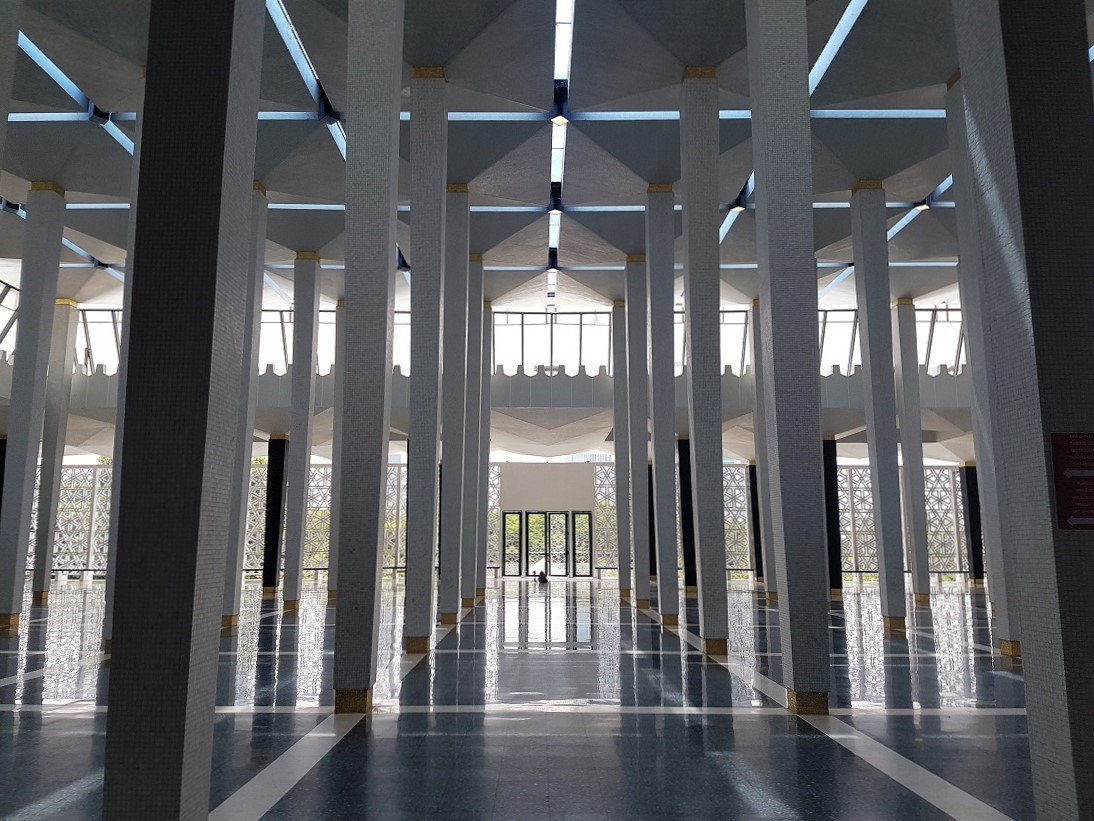
It’s a dazzling complex featuring white tiled walls with purple accents (above) and a 240ft-high minaret (below).

The blue-green tiled roof is a star-shaped dome with 18 points – one for each of the 13 Malaysian states and the five pillars of Islam.
It’s a spectacular building and I was glad we’d taken the time to visit as I enjoyed looking around and photographing it from various angles.
All three buildings represent different aspects of the country’s past and present, and after my visits, I couldn’t wait to explore more of the Malaysian capital.
 Little Old World
I love the National Palace and how the white and gold royal building stands out against the blue sky and several small green mounds that surround it. Thanks for sharing, and have a good day 🙂 Aiva xx
LikeLike
Thanks Aiva, the national palace is an impressive sight 🙂
LikeLiked by 1 person
🥰🥰🥰
LikeLike
I thought I would recognise KL, but I don’t! I would have to find our photos to compare. What I do remember, apart from it being busy, was the vast number of women in black burkas whereas the other places we had been a headscarf was the most we saw. We wondered if they were tourist from eg Saudi. It was strange to see groups of young women taking photos of each other when you couldn’t see their faces.
LikeLiked by 1 person
There was a lot of construction work going on around the city while I was there, so I suspect it looks different again now! I can’t say I noticed that in KL, there were lots of people in Western style dress and a fair few in headscarves.
LikeLiked by 1 person
It’s a bit of a bummer to hear that Kuala Lumpur is not very walking friendly and that transit doesn’t go to many of the popular spots. Beautiful captures. I especially like the shots of the National Mosque of Malaysia. Everything looks so clean and visually appealing.
LikeLiked by 1 person
It wasn’t at all walking friendly, hopefully it’s changed since. At one point, I had to do an hour-long detour along the edge of a dual carriageway to get from one part of the city to another that in theory should have taken 10 minutes at most if there had been a straightforward path. Thank you 🙂 The mosque was beautiful and so photogenic. It was a lovely building to photograph.
LikeLiked by 1 person
This is great – I’m heading to KL in a matter of weeks, and this is making me all excited. Grab is downloaded 🙂
LikeLiked by 1 person
Have an amazing time in KL, it’s a great city! If you have any questions before you go, you know where to find me 🙂
LikeLiked by 1 person
It’s too bad that getting to such popular spots is so difficult. Beautiful pictures of the buildings- I love the mix of the old styles and that very modern feel. 🙂
LikeLiked by 1 person
It’s the least pedestrian-friendly city I’ve been to, which surprised me. The buildings were beautiful and very photogenic. There’s a real mix of architectural styles in KL, from ultra modern skyscrapers to old British colonial buildings.
LikeLiked by 1 person