
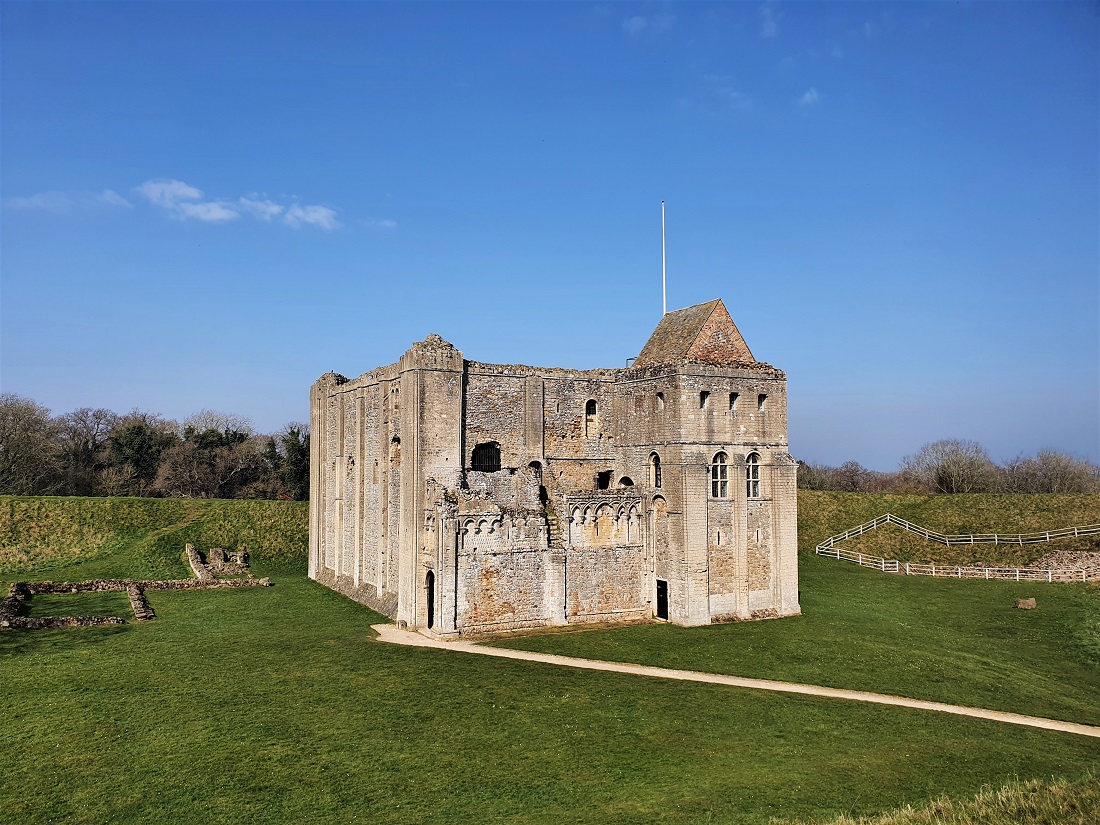
With its extraordinarily well-preserved keep that’s surrounded by uncommonly tall earthworks, the castle at Castle Rising is one of the most memorable and unusual in the UK.
Situated in the small, charming Norfolk village a few miles north of King’s Lynn (below), the castle has an illustrious history.

Built in the 12th century by William D’Aubigny, Earl of Arundel and husband of Queen Adeliza (Henry I’s widow), the castle was sold to Queen Isabella (Edward II’s widow) in 1331, who spent the last 25 years or so of her life in luxurious retirement there.
The castle remained in royal hands until 1544 when Henry VIII sold it to Thomas Howard, the Duke of Norfolk (uncle of wives two and five, Anne Boleyn and Catherine Howard), whose family has owned it ever since.

Most of the castle was later knocked down – only the keep and the earthworks really remain – and in the 19th century, it was restored by the Howard family, who opened it up to the public.
Over the years, the keep’s also played host to a jail, a constabulary and an asylum.

On arriving, I was stunned to be greeted by an enormously tall, grass-covered mound – the earthworks that encircle the castle (above).
I’ve visited many a castle in my time, but I’ve never seen earthworks quite like these.

Thanks to their height, the keep is almost entirely shrouded from view and it was only when I strolled around to the entrance that I got my first glimpse of what was inside (above).

Crossing the bridge and passing under the stone archway, I stopped to admire the magnificent keep, then set off to explore the site, starting with the earthworks.

There’s a path along the top of the earthworks, so I climbed the stairs (above) and followed the path around to get a better look at my surroundings.

It was a fantastic way to get a feel for the site, which also includes the ruins of the royal apartments and chapel (above), and an early Norman church (below).

Having walked around the earthworks, I headed to the early Norman church, which is in slightly better shape than the royal apartments, where I made my way down the steps to get a closer look (below).

From there, I crossed the field to look at the ruins of the 14th century chapel and the royal apartments where Isabella once lived (below).

In Isabella’s time, the apartments would have been decorated with painted cloth and black carpets, and it’s said she preferred living here to the keep, as the keep wasn’t quite up to her standards.
There’s barely anything left of the apartments, but it was fun trying to imagine how they may have looked in Isabella’s time.
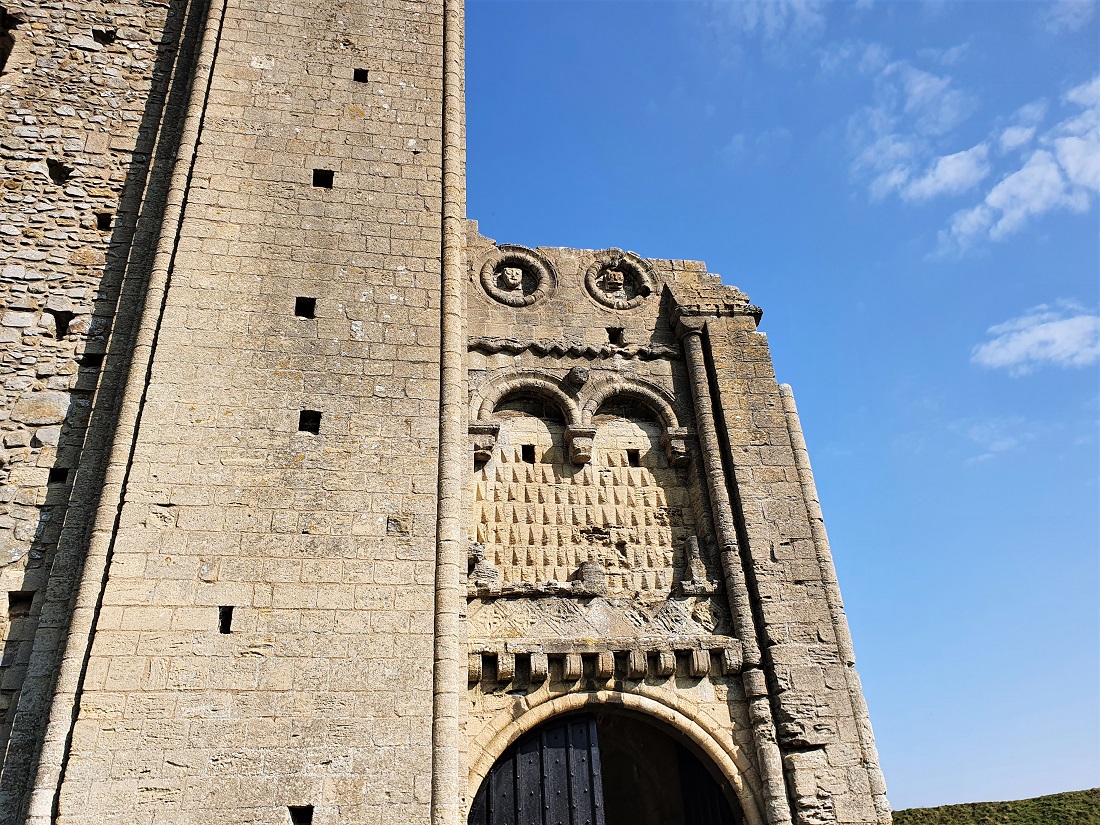
I then turned my attention to the keep. Built from local Barnack stone (like Ely Cathedral), the forebuilding is one of the best preserved in England and the carvings above the door caught my eye as I went inside (above).
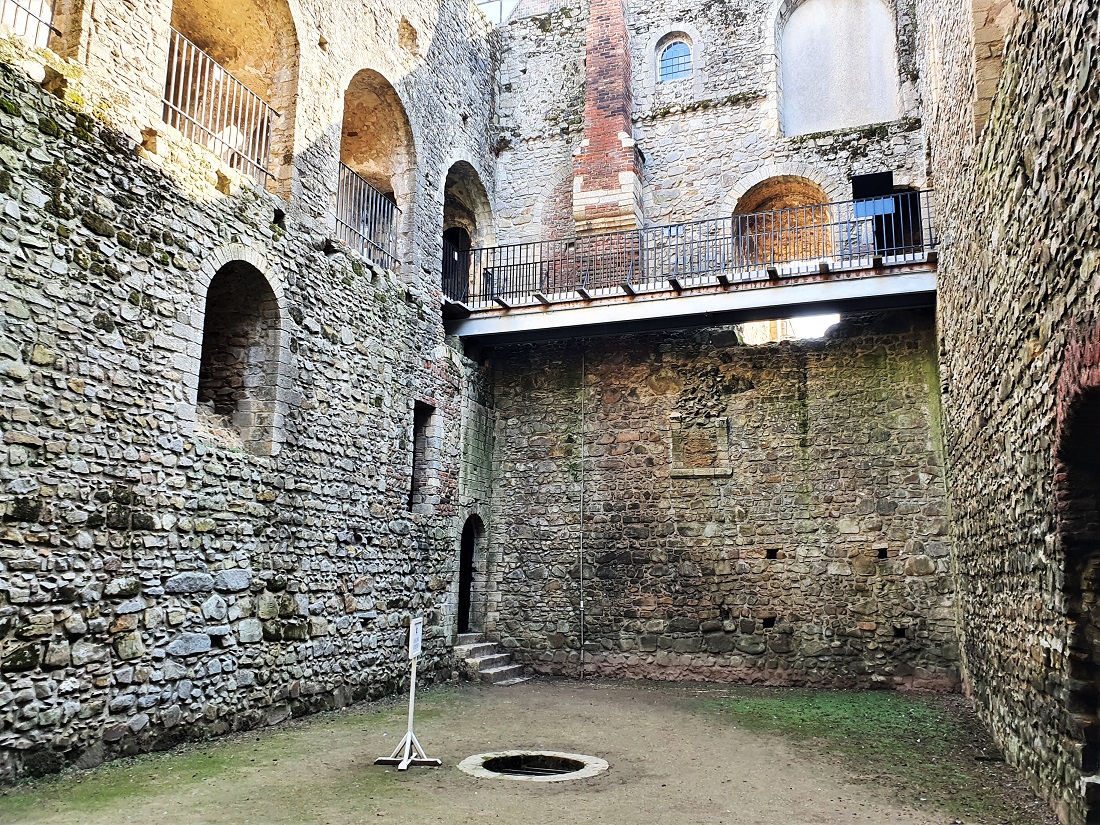
I started my visit on the ground floor, where I found myself in what would have been the basements under the great hall and the great chamber (above).
As I looked around, I was amazed by how high the walls were and how well-preserved the structure was.
It was easy to get a sense of the layout of the keep and how the different rooms fitted together. It’s one of the few castles I’ve visited where I could imagine people living there.

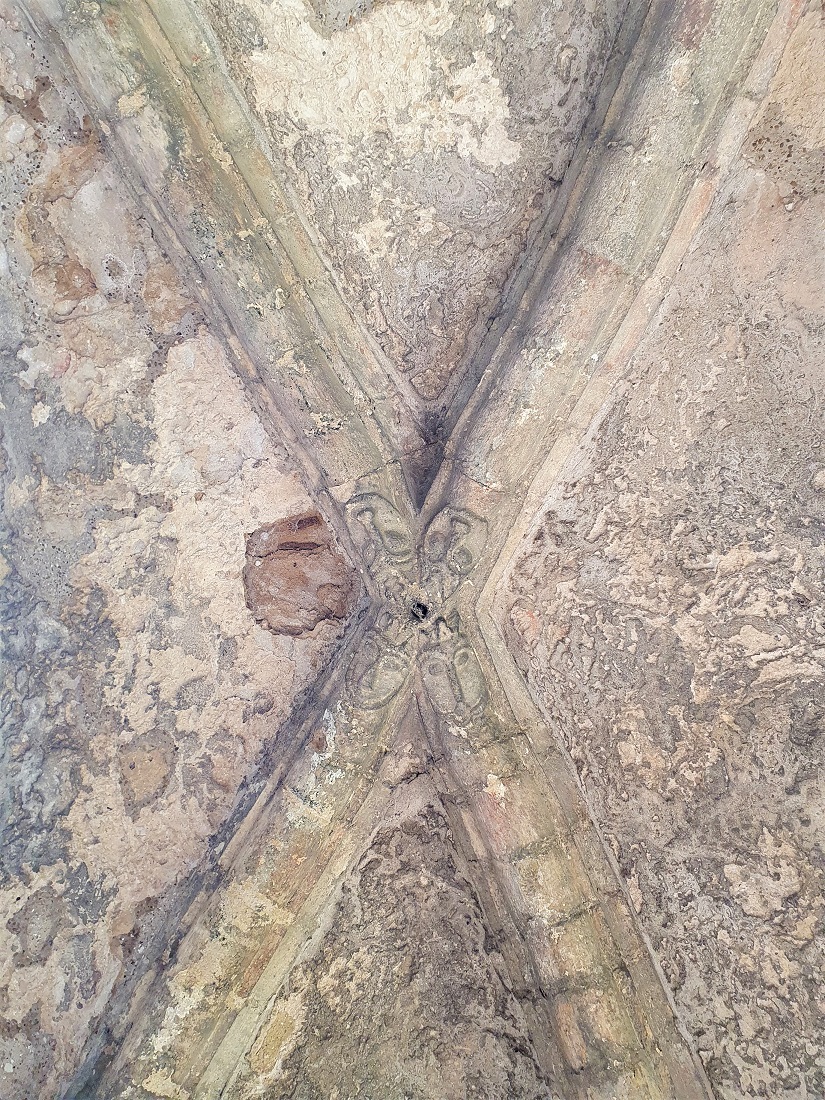
One of the things I really liked about the keep – aside from how intact it was – was the architectural detail, such as the remains of the fireplace and the faces carved on the ceiling (above). It gave it an almost homely feel.

Having looked around the ground floor, I made my way up the stairs (above) to the forebuilding and vestibule waiting room, both of which were in surprisingly good condition.

Once upon a time, the forebuilding would have led to the great hall but this was blocked off after the great hall’s floor collapsed in the 16th century.
I particularly liked the forebuilding’s vaulted ceiling, which dates to the 13th or 14th centuries (above).
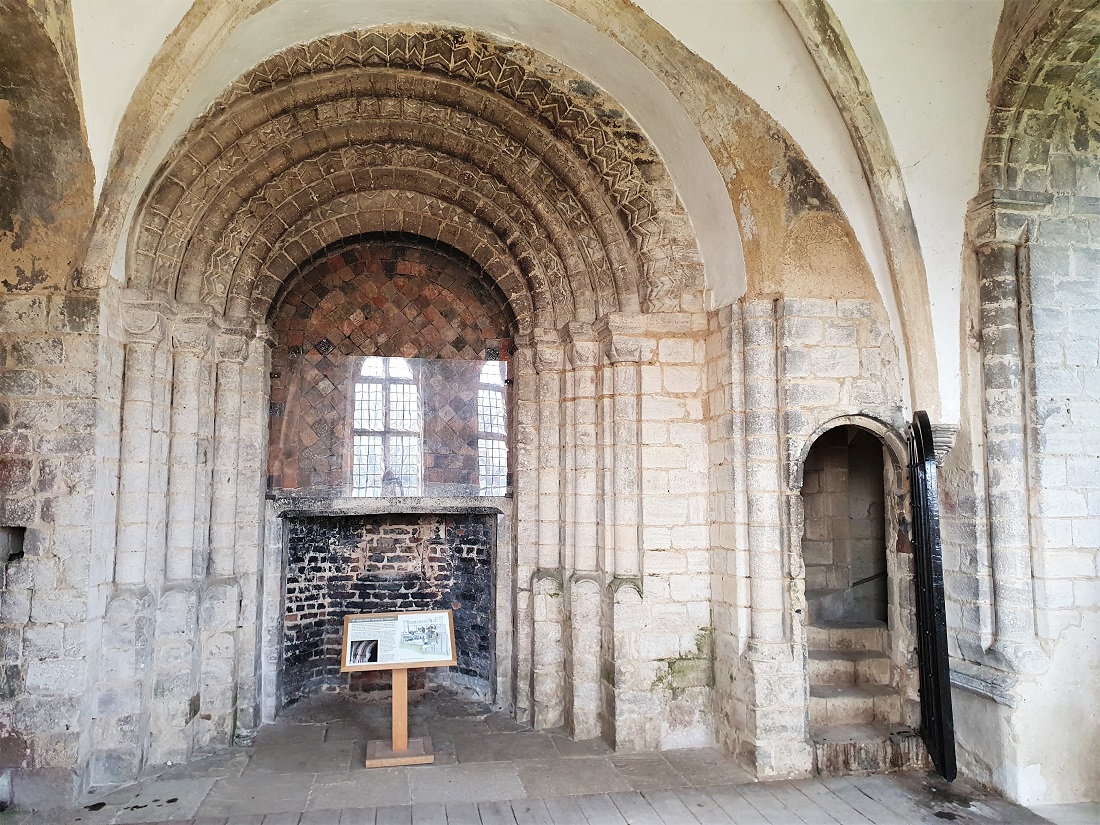
The waiting room is, as its name suggests, where the castle’s guests would pause before being taken to the royal apartments or great hall, and it, too, boasts some lovely decorative features (above).

I carried on up the stairs, where there are various passages, rooms, and nooks and crannies to explore.

The rooms include a small, reasonably intact and well-preserved chapel (above) and the old kitchens.
The kitchens were where the servants prepared the food that was served in the great hall until they fell out of favour in the 15th century and were replaced by newer kitchens next to the royal apartments.
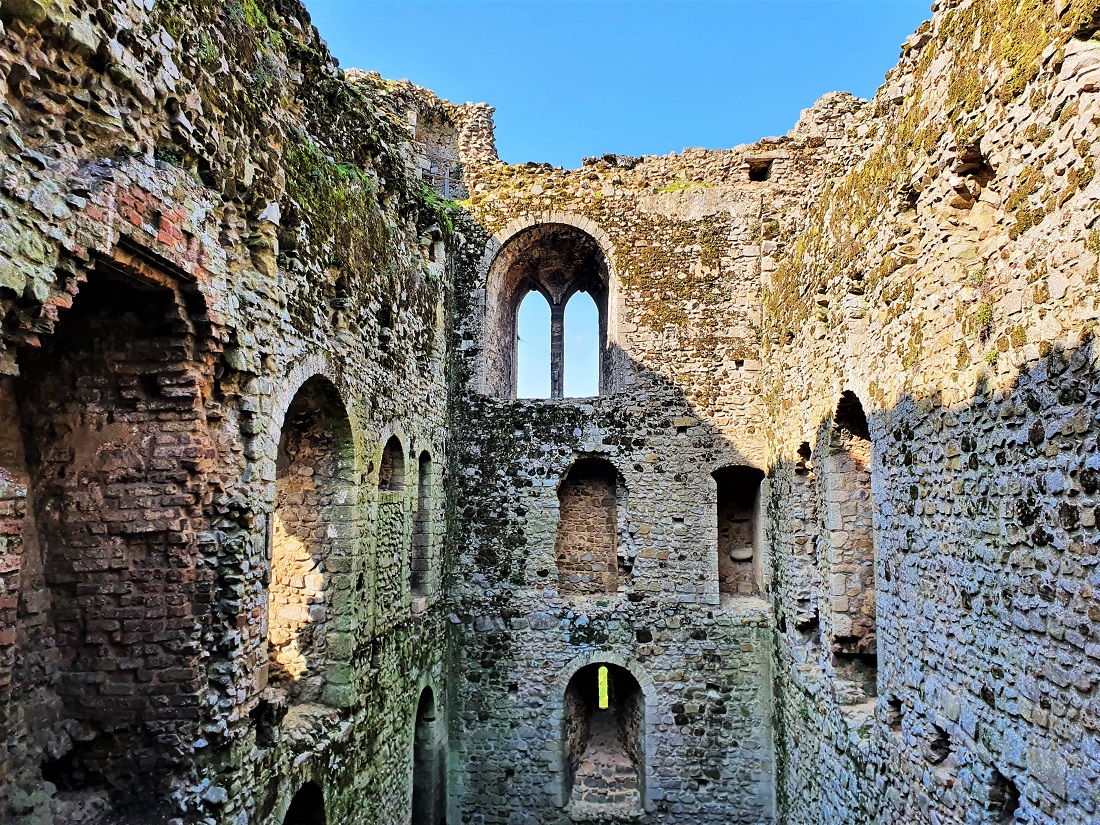
From the upper floors, you can look out over what would have been the great hall and the great chamber (above), and you can clearly make out where the floors and roof would have been, which further helped me get a sense of how the keep may have looked.

By now I’d seen all there was to see, so I left the castle and strolled to the village.
Castle Rising is also owned by the Howard family and it’s a lovely, well maintained village full of picture-perfect houses.
Aside from the castle, the most notable building is the attractive 12th century St Lawrence’s Church (above).
I really enjoyed my visit to Castle Rising. I’ve been to many a castle in my time, but I’ve never seen one quite like Castle Rising’s.
Its keep is extraordinary and in fabulous condition, and I loved how easy it was to picture how it would have looked in the Middle Ages.
Often when I visit castles I struggle to imagine what it would have been like to live there, but I didn’t have that trouble at Castle Rising. The earthworks that surround the castle are impressive, too, and unlike any others I’ve seen.
The castle’s fairly small, so it doesn’t take long to look around. But it’s a curious place and worth a visit if you’re in the Norfolk or Cambridgeshire area and like a castle.
Info
Castle Rising, Lynn Road, King’s Lynn PE31 6AH
Open 10am to 6pm daily (1 April to 1 November), 10am to 4pm Wednesday to Sunday (2 November to 31 March)
castlerising.co.uk
 Little Old World
Great read. Thank you.
LikeLiked by 1 person
Thank you 🙂
LikeLiked by 1 person
You can really imagine these famous names walking in those halls, entertaining and plotting schemes can’t you. Did you find the purpose for the mounds? Maggie
LikeLiked by 1 person
Thanks Maggie, you really can. It was fun imagining what may have gone on in the castle. No, I couldn’t find any concrete information about them. Although the castle was more of a fancy hunting lodge than a defensive fortress, I suspect they were designed for defensive purposes because the surrounding area is flat.
LikeLiked by 1 person
A gem of a castle, I agree!
LikeLiked by 1 person
It really is, it’s fantastic!
LikeLiked by 1 person
I love the name Castle Rising. Sounds very majestic. The castle looks great in it’s surroundings.
LikeLiked by 1 person
It’s an excellent name, isn’t it? It does sound very grand and majestic. It’s a curious and unusual castle, and I had fun looking around it.
LikeLiked by 1 person
What an amazing castle!
LikeLiked by 1 person
It really is, it’s a fabulous place!
LikeLiked by 1 person
What a magnificent castle. I can’t believe how well-kept it is. Thank you for sharing with us!
LikeLiked by 1 person
Thanks Rosie! It’s an incredible castle. I was surprised by how well preserved it is, it’s in really good condition.
LikeLiked by 1 person
I can’t decide what I love more- the great name of Castle Rising or the fact that it is most hidden behind the circle of earth. That is very clever to hide a castle in the natural surroundings. The castle ruins look really interesting and a great place to wander around and imagine the people who lived there. 🙂
LikeLiked by 1 person
Thanks Meg, it’s a fantastic name, isn’t it? I don’t think I’ve come across another castle that’s effectively hidden by the earthworks that surround it, it’s really unusual and I hadn’t expected to find it at Castle Rising. It was a great castle to explore, full of nooks and crannies, and it was easy to imagine various royals, dukes and duchesses living there in past times 🙂
LikeLiked by 1 person
Looks like you had lovely weather to explore the Castle Rising. It’s a shame that most of the original castle was knocked down, but it’s amazing how well preserved the keep is.
LikeLiked by 1 person
Thanks 🙂 The weather was fantastic and unseasonably warm. The keep’s in surprisingly great condition and I agree, it’s a shame they knocked down the rest of it. It’s such an unusual castle, it would have been cool to get a better idea of what the entire complex once looked like.
LikeLiked by 1 person
Looks like you had it to yourself, and the central keep is really well preserved. I kept trying to go last year, but it was closed for a long period of time. I definitely need to get there in 2025.
LikeLiked by 1 person
Thanks Hannah, I went on a weekday morning, so there was one other couple there when I visited, which was great. The keep’s extraordinarily well preserved and I was surprised by how much there was to see. It’s a shame you weren’t able to visit last year but I hope you make it this year. It’s a quirky little castle 🙂
LikeLike
Beautiful castle with such an interesting history. You were lucky with the weather.
LikeLiked by 1 person
Thanks Mélodie. It’s a really interesting and unusual castle, I enjoyed my visit. The weather was beautiful and unseasonably warm.
LikeLiked by 1 person