
Tucked away in a valley in the Chiltern Hills you’ll find Hughenden, the country pile of former British Prime Minister Benjamin Disraeli.
Queen Victoria’s favourite PM bought the 1,500-acre estate in the Buckinghamshire countryside in 1848 as a country retreat and lived there with his wife Mary Anne when he wasn’t in London.

The estate dates back to at least Norman times, when it was owned by William the Conqueror’s brother, Odo, Bishop of Bayeux.
The current red-brick house was built in the late 18th century and was redesigned by the architect Edward Buckton Lamb for the Disraelis in 1862.
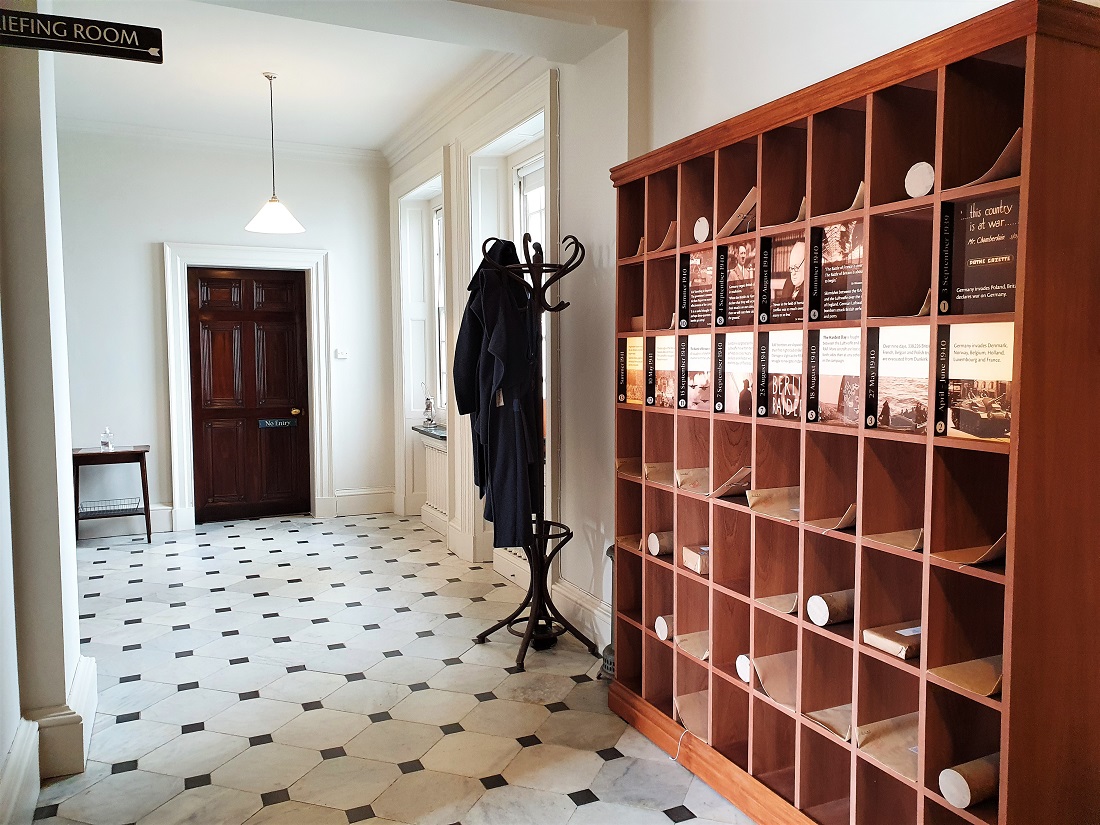
In 1937, it was turned into a museum, but during the Second World War, it was taken over by the UK Air Ministry and used as a top secret map making and aerial reconnaissance base (above).
Today, the estate is in the care of the National Trust.

I started my visit with a tour around the attractive manor house, where I was greeted by a friendly volunteer.
The house is set across three floors and I began by looking around the ground floor rooms.

My first port of call was the magnificent library, which is home to more than 3,300 books (above).

Unusually, it wasn’t the books that caught my eye as I walked around, but the foot on the desk (above).
Apparently, it’s a marble replica of Mary Anne’s foot, which Disraeli used as a paperweight.

I carried on and found myself in the sumptuously decorated drawing room, where a huge portrait of Mary Anne hangs over the fireplace (above).

Moving through a series of rooms overlooking the south lawn, I finished up in a large room that houses a small exhibition about Disraeli (above).
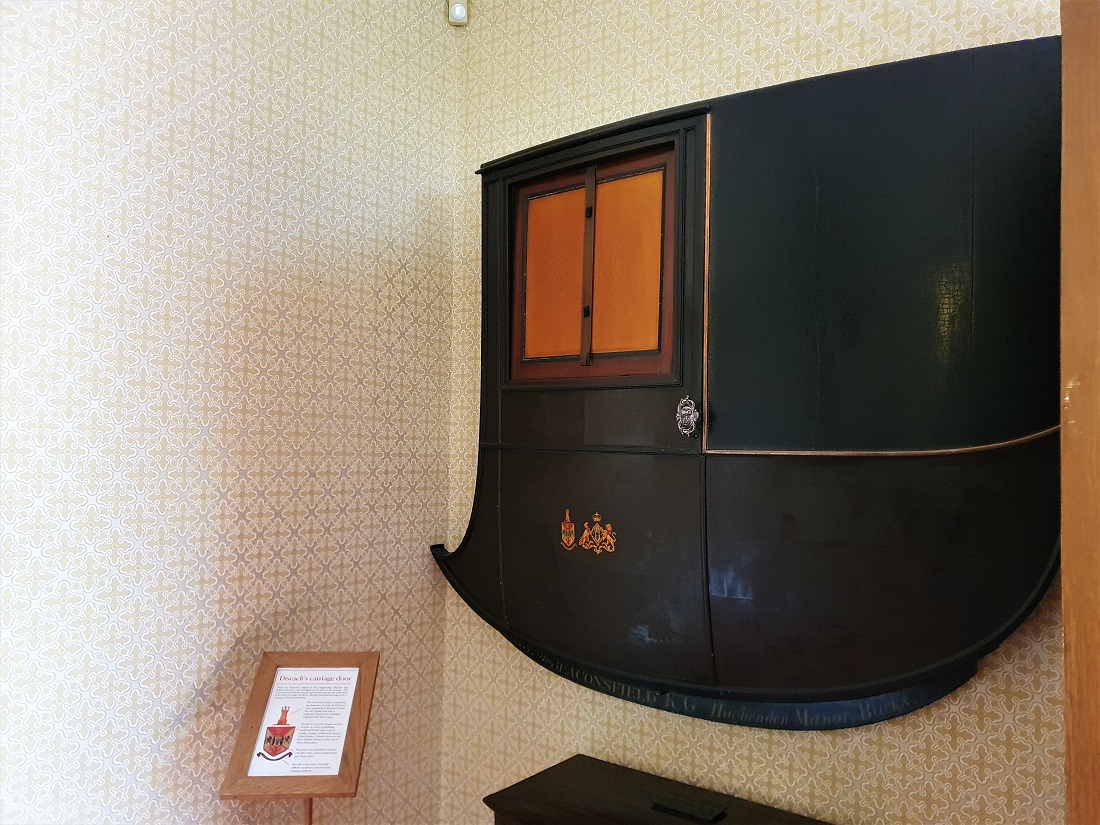
The room was filled with random artefacts relating to Disraeli’s private and public life, including the door of his carriage, which is adorned with Disraeli’s crest (above).

Upstairs, there were various rooms open to visitors, including the boudoir where Mary Anne used to do her work, along with Disraeli’s study (above).
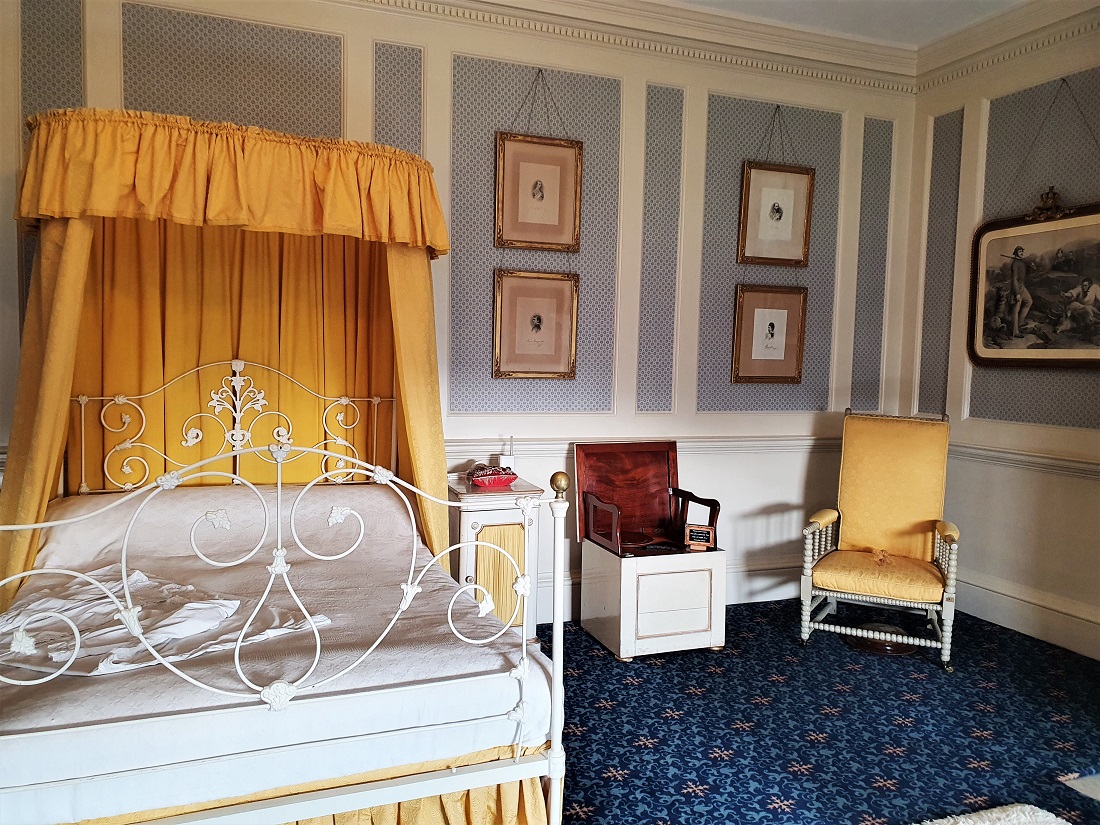
My favourite room was the spacious bedroom, which looked like a comfortable room in which to spend a night (above and below).

The house is furnished as it would have been in the Disraelis’ time, but I can’t say I was a big fan of the decor.
It was bit too busy and there were a few too many patterns for my taste.

When the National Trust was given the house by the Disraelian Society in 1947, it was also gifted some 7,000 artefacts, and there are items from the collection throughout the house.

One of the most notable is a fan that was given to Disraeli at the Congress of Berlin in 1878 (above).
The congress recognised Romania, Montenegro and Serbia as independent states after the end of the war between Russia and the Ottoman empire, and the fan is signed by the main players from the conference.

I finished my tour of the living quarters in the grand and very Victorian-looking dining room (above).
It’s a striking room and suitably lavish for hosting Queen Victoria, as Disraeli did in 1877.

From the main body of the house, I made my way to a series of rooms that tell the story of the top secret reconnaissance work that took place at Hughenden during the Second World War.
Code named Hillside, the mansion was taken over by the UK Air Ministry and played host to around 100 people, who analysed aerial photographs of Germany and drew up maps for bombing raids.

Amazingly, the facility was so top secret that no-one knew about it until 2004 when one of the volunteers overheard a member of the public telling their grandson about their time at Hillside during the war.
It’s a fascinating story and crazy to think that if it hadn’t been for that visitor, the whole incredible history might still be unknown to this day.

By now, I’d seen all there was to see in the house, so I headed outside to explore the grounds.
I started in the Italianate-style parterre garden, which was installed by Mary Anne to the south of the mansion (above).
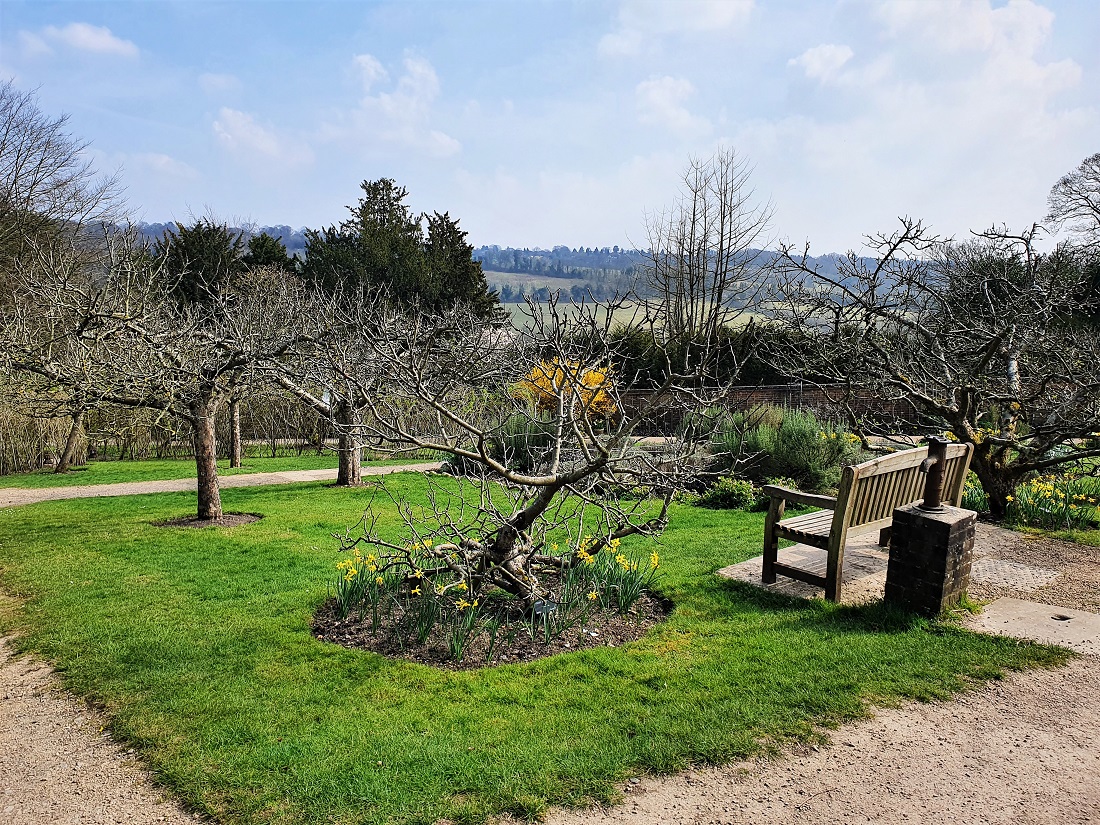
I then strolled through the pleasure gardens up to the walled garden, where there wasn’t much to see other than a few daffodils (above).
After a spot of lunch in the Stableyard Café, I set off to explore the wider estate.
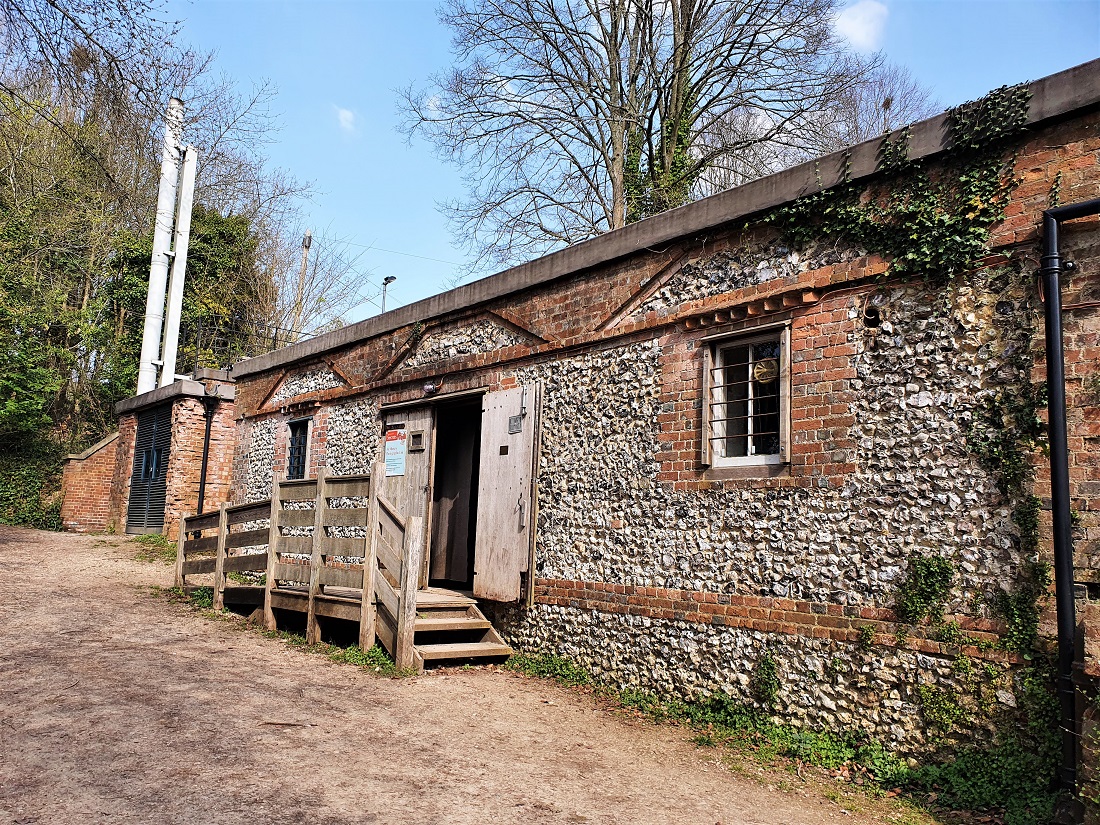
As I made my way towards the woods, I spied an intriguing looking brick building, which was open to visitors (above). So I stopped to take a look around.

Inside, the building was set out like a top secret facility from the Second World War, complete with an area for developing photographs (below).

It was possibly the most unusual dark room I’ve come across.
From the outbuilding, I decided to follow the purple way markers that mark the German Forest Walk, one of three walking trails around Hughenden.

The trail took me into Manor Wood, then up past some beautiful views of the Chiltern Hills (below) to Flagmore Wood and around to the estate’s Hanging Wood.

While there were quite a few people in the mansion, the woods were a different story and I didn’t come across many people, which made for a pleasant and relaxing stroll.

I really enjoyed the walk, so at the end of the German Forest Walk, I decided to keep going by following the blue way markers of the Woodcock Walk.
It’s a 2km trail that took me up through Woodcock Wood, across a couple of fields and back down to my starting point via a country lane.
The Hughenden estate is steeped in history and I was fascinated to learn about Hillside during my visit. It’s amazing to think it remained a secret for so long and its story only came out by accident.
The various walking trails around the woods made for a great, relaxing stroll, too, and all in all, I had an enjoyable day out at Hughenden.
Info
Hughenden, High Wycombe, Buckinghamshire HP14 4LA
nationaltrust.org.uk/visit/oxfordshire-buckinghamshire-berkshire/hughenden
 Little Old World
What an interesting place to visit. Thank you!
LikeLiked by 1 person
Thank you 🙂 It has a fascinating history and made for a nice day out.
LikeLiked by 1 person
That’s quite the country home!
LikeLiked by 1 person
Thanks, it really is! It has such an interesting past.
LikeLiked by 1 person
We have a Beaconsfield Rd near us which I knew was called after Disraeli’s title, but it has only just struck me that just across the main road is Hughenden Rd which must also be a tribute to him. I guess he must have been PM when the streets were laid out.
LikeLiked by 1 person
Ah, how interesting! It’s funny how streets are often named in clusters, but the themes or meanings get lost in the mists of time.
LikeLiked by 1 person
We visited last spring and enjoyed this place.
LikeLiked by 1 person
Thanks Mélodie! Glad to hear you enjoyed it, too 🙂
LikeLike
It looks lovely – I’d really love to have a walk around 🙂 The stroll afterwards looks lovely too!
LikeLiked by 1 person
Thanks Hannah 🙂 It was a really interesting historic house and the walking trails around the estate were great and so peaceful.
LikeLike
Thanks for the tour and history lesson. It’s neat to hear how the facility was top secret for so long. The grounds look like a lovely spot to explore as well.
LikeLiked by 1 person
Thanks! I was amazed to learn that Hillside had remained secret for so long and that its story only came out by accident. They did an excellent job keeping it a secret, but it’s cool that we now know about it. The grounds were lovely and relaxing.
LikeLiked by 1 person
That is a beautiful estate. The decor is a little busy for me too, but it is very Victorian. I love that there is this beautiful manor that probably made a perfect secret facility during WWII. Because who would think to look for that here. Great tour! 🙂
LikeLiked by 1 person
It’s so Victorian, isn’t it? I can picture Queen Victoria having lunch there. You wouldn’t think from the rest of the house or the estate that it could have been a top secret military base, so it really was a great choice. Thanks Meg 🙂
LikeLiked by 1 person
Thanks for this house tour!what a great place!
LikeLiked by 1 person
Thanks Tanja! It was an interesting house and the estate was a lovely place for a walk.
LikeLiked by 1 person